
Understanding Skin, Hair and Chemical Peels for Aesthetic Students

Healthy aesthetic practice starts below the surface. A cleanser, peel, laser, serum, microneedle, or hair treatment only makes sense when the skin and hair structures underneath are understood.
For students at Mesoderma Academy, this foundation is more than theory. It helps with client assessment, treatment planning, risk reduction, and explaining procedures clearly. The BASIC STRUCTURE OF SKIN, HAIR & CHEMICAL PEELS gives students a practical map of what they are treating, why responses differ, and how to support safe outcomes.
This guide is intended as A Comprehensive Student Guide for MEC — Mesoderma Academy, with a focus on core anatomy and its link to aesthetic care. It is educational only and does not replace medical diagnosis, prescribing, or supervised clinical training.
The integumentary system protects, senses, regulates, and communicates
The integumentary system includes the skin, hair, nails, sweat glands, and oil glands. It is often described as the body’s largest organ system because it covers and protects the internal tissues from the outside world.
In aesthetics, it is easy to think of skin only in terms of appearance. In reality, skin is active, responsive tissue. It reacts to heat, friction, bacteria, allergens, hormones, ultraviolet light, products, and procedures.
The key functions of the integumentary system include:
Protection
Skin forms a barrier against microbes, chemicals, physical injury, pollution, and ultraviolet exposure.
Temperature regulation
Sweat glands release fluid that cools the body. Blood vessels in the skin can widen or narrow to release or conserve heat.
Sensation
Nerve endings detect pressure, pain, temperature, touch, and irritation. This matters during treatments that cause stinging, warmth, or tenderness.
Immune defence
Skin contains immune cells that detect threats and help start inflammatory responses.
Water balance
The outer barrier helps reduce water loss. When this barrier is damaged, skin often becomes dry, tight, sensitive, or irritated.
Vitamin D production
Skin helps produce vitamin D when exposed to ultraviolet B radiation, though safe sun habits remain essential.
Communication
Redness, swelling, flaking, pigmentation, oiliness, and lesions all communicate useful information about internal and external influences.
For aesthetic students, these functions shape how skin reacts before, during, and after treatment. A peel, for example, is not simply “removing dead skin.” It is creating a controlled injury to encourage renewal. The skin’s barrier, immune response, pigment activity, and healing ability all affect the result.
Why skin and hair anatomy matters in aesthetic procedures
Anatomy gives structure to clinical judgement. Without it, treatment choices can become guesswork.
A student who understands anatomy can better answer questions such as:
Is this client’s barrier strong enough for a chemical peel?
Is redness linked to sensitivity, inflammation, vascular reactivity, or recent product use?
Could this pigmentation worsen with aggressive treatment?
Is hair growth affected by the follicle cycle, hormones, inflammation, or breakage?
Which treatment depth is appropriate for this concern?
Aesthetic procedures often target specific structures. Chemical peels affect the epidermis and, in some cases, the upper dermis. Microneedling creates channels through the epidermis into the dermis. Hair removal treatments focus on the follicle and surrounding structures. Topical products often work at the level of the stratum corneum, pigment pathways, sebaceous activity, or hydration balance.
A clear understanding of anatomy also improves communication. Clients may arrive asking for a peel, brightening treatment, or hair restoration support. The practitioner’s role is to assess what is visible, ask the right questions, identify risk factors, and explain realistic outcomes.
Skin anatomy begins with three main layers
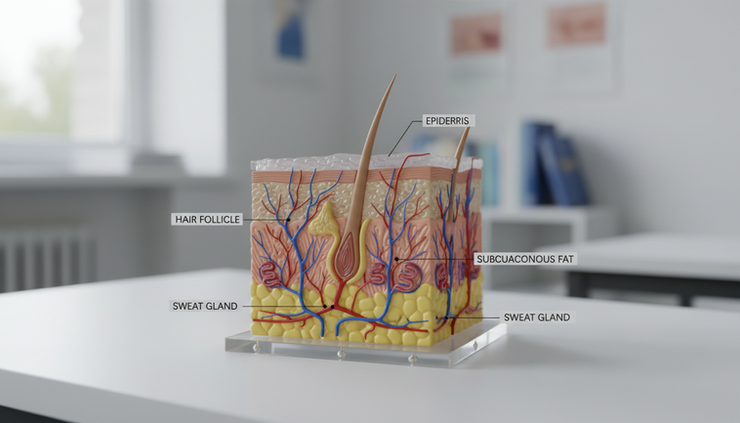
Skin has three broad layers: the epidermis, dermis, and subcutaneous tissue. Each layer has different structures, roles, and treatment relevance.
The epidermis is the outer protective layer
The epidermis is the outermost layer of the skin. It has no blood vessels of its own and receives nutrients from the dermis below.
Its main cells include:
Keratinocytes
These produce keratin and form most of the epidermis. They move upward as they mature, then become flattened cells at the surface.
Melanocytes
These produce melanin, the pigment that influences skin colour and helps protect against ultraviolet damage.
Langerhans cells
These immune cells help detect foreign substances.
Merkel cells
These contribute to touch sensation.
The epidermis is arranged in layers. From deepest to most superficial, these include the basal layer, spinous layer, granular layer, clear layer in thicker skin, and stratum corneum.
The stratum corneum is especially important in aesthetics. It is made of flattened dead cells surrounded by lipids. A useful analogy is bricks and mortar: the skin cells are the bricks, and the lipids are the mortar. When the mortar is damaged, water escapes and irritants enter more easily.
Chemical exfoliants, retinoids, harsh cleansing, weather changes, and over-treatment can affect this barrier. A damaged barrier may appear red, tight, shiny, flaky, rough, or unusually reactive.
The dermis gives skin strength, support, and nourishment
The dermis sits under the epidermis. It contains blood vessels, lymphatic vessels, nerves, collagen, elastin, fibroblasts, hair follicles, sweat glands, and sebaceous glands.
Two major dermal proteins matter in aesthetic work:
Collagen
Collagen gives skin firmness and structural support.
Elastin
Elastin helps skin stretch and return to shape.
Fibroblasts produce collagen, elastin, and other matrix components. Many rejuvenation procedures aim to stimulate fibroblast activity through controlled injury, though results vary based on age, health, skin condition, and treatment method.
The dermis also contains important sensory nerves. This explains why deeper treatments may feel more intense than surface exfoliation. Vascular supply in the dermis supports healing, but it also contributes to visible redness, flushing, and bruising.
The subcutaneous layer cushions and shapes
The subcutaneous layer, also called hypodermis or subcutis, lies beneath the dermis. It contains fat cells, connective tissue, larger blood vessels, and nerves.
This layer helps with insulation, cushioning, and body contour. It also affects facial volume and the way ageing appears. While superficial treatments may not directly target this layer, assessment of facial contour, volume loss, and skin laxity needs an understanding of what lies beneath the dermis.

Hair anatomy is closely linked to skin health
Hair is part of the integumentary system and grows from follicles located in the dermis. Each follicle is a small but active mini-organ.
The main parts of hair anatomy include:
Hair shaft
The visible part above the skin surface. It is made mostly of keratin.
Hair root
The part below the skin, anchored in the follicle.
Hair bulb
The expanded base of the follicle where growth activity takes place.
Dermal papilla
A structure at the base of the bulb that supplies signals and nutrients to support hair growth.
Sebaceous gland
This gland opens into the follicle and produces sebum, an oily substance that lubricates skin and hair.
Arrector pili muscle
A tiny muscle attached to the follicle. It contracts during cold or emotional responses, creating “goosebumps.”
Hair growth follows a cycle:
Hair cycle phase | What happens | Aesthetic relevance |
Anagen | Active growth phase | Many hair treatments work best when follicles are active |
Catagen | Short transition phase | Growth slows and the follicle changes |
Telogen | Resting phase | Shedding can occur after this phase |
Exogen | Release of the hair shaft | Visible shedding may increase temporarily |
Hair concerns can be complex. Breakage, thinning, excess growth, folliculitis, dandruff-like scaling, and inflammation may have different causes. Some require medical referral. Aesthetic students should learn what can be managed within their scope and what needs clinical assessment.
Understanding the follicle also matters for skin treatments. Follicles can act as pathways for sebum, bacteria, keratin buildup, and inflammation. Acne, ingrown hairs, and folliculitis all involve follicular structures.
Skin types and conditions guide safe treatment choices
Skin does not respond the same way in every client. Good aesthetic practice starts with observation, consultation, and careful selection.
Skin types describe general patterns
Common skin type categories include:
Normal skin
Balanced oil and hydration, usually with fewer sensitivity concerns.
Dry skin
Reduced oil or impaired barrier function, often with tightness, flaking, roughness, or dull appearance.
Oily skin
Increased sebum production, often linked with shine, enlarged-looking pores, congestion, or acne tendency.
Combination skin
Oilier in some areas, often the T-zone, and drier in others.
Sensitive skin
More reactive to products, temperature, friction, fragrance, exfoliants, or procedures.
These categories help start the assessment, but they are not enough on their own. A client can have oily skin and a damaged barrier. Another can have dry skin with active acne. A treatment plan must consider both type and condition.
Skin conditions need closer assessment
Common conditions relevant to aesthetic procedures include:
Acne and congestion
Post-inflammatory hyperpigmentation
Melasma-like pigmentation patterns
Rosacea-prone redness
Dehydration
Barrier impairment
Sun damage
Fine lines and texture changes
Scarring
Eczema-prone or dermatitis-prone skin
Some conditions increase treatment risk. For example, active inflammation can make the skin more reactive. Pigment-prone skin may need conservative peel selection and strong photoprotection. A compromised barrier may need repair before exfoliation.
Fitzpatrick skin type is also commonly used to describe how skin responds to ultraviolet exposure and its tendency to burn or tan. In aesthetics, it helps guide risk awareness, especially for pigmentation changes, but it should not replace a full consultation.
Treatment relevance means asking the right questions
Before any active treatment, a practitioner should ask about:
Current skincare products, including retinoids and acids
Recent treatments, waxing, shaving, peels, lasers, or injectables
Medications that may affect healing or sensitivity
History of cold sores when treating around the mouth
Pregnancy or breastfeeding, where relevant to treatment choice
Allergies and past reactions
Sun exposure and tanning habits
Keloid or hypertrophic scarring tendency
Active infection, open wounds, or unexplained lesions
When in doubt, delay treatment and refer appropriately. Safe aesthetics includes knowing when not to treat.

Chemical peels use controlled exfoliation to renew the skin surface
Chemical peels apply an active chemical solution to the skin to create controlled exfoliation. Depending on the agent, concentration, pH, application time, skin preparation, and client factors, the peel may act superficially or more deeply.
Peels are often used to improve:
Dullness
Uneven texture
Superficial pigmentation
Congestion
Mild acne-prone skin
Fine surface lines
Roughness from sun exposure
A peel is not suitable for every person or every concern. Student practitioners must understand both the chemistry and the skin response.
Peel depth affects risk and recovery
Chemical peels are often described as superficial, medium-depth, or deep.
Peel depth | General target | Typical aesthetic relevance |
Superficial | Stratum corneum and upper epidermis | Brightness, texture, mild congestion, gentle exfoliation |
Medium-depth | Epidermis and part of upper dermis | More visible resurfacing, higher risk, longer recovery |
Deep | Deeper dermal effect | Medical-level procedure with significant risk and recovery |
Most beginner and many routine aesthetic peels are superficial. Medium and deep peels require advanced knowledge, strict protocols, and appropriate clinical oversight.
Common peel ingredients include alpha hydroxy acids such as glycolic acid, lactic acid, and mandelic acid, beta hydroxy acid such as salicylic acid, and other peeling agents used in specific clinical protocols. The same named acid can behave differently depending on formulation. Percentage alone does not tell the full story.
Patient selection determines whether a peel is appropriate
Good peel outcomes depend on correct patient selection. A peel may be unsuitable, delayed, or modified if the client has:
Active infection or open wounds
Significant sunburn or recent tanning
Severe barrier damage
Uncontrolled inflammatory skin disease
Recent aggressive exfoliation or resurfacing
Certain medication use affecting healing
Known allergy to peel ingredients
Unrealistic expectations
Poor ability to follow aftercare
Students should learn to separate a client’s goal from their current suitability. Someone may want brighter skin, but if the barrier is inflamed and peeling already, a chemical peel could worsen irritation. In that case, barrier repair comes first.
Patch testing and consent support safer practice
Patch testing may be used when suitable, especially for reactive skin or new formulations. It cannot guarantee that a reaction will not happen, but it can reduce uncertainty.
Clear consent is also essential. Clients should understand:
What the peel is intended to do
What sensations may occur
What visible reactions are expected
What risks are possible
What aftercare is required
When to seek help
A good consultation protects both the client and practitioner. It also builds trust.
Post-peel care protects the barrier while skin renews
After a chemical peel, the skin barrier may be temporarily more vulnerable. Post-care reduces irritation and supports healing.
Common post-peel guidance often includes:
Use a gentle cleanser
Apply a simple, suitable moisturiser
Avoid picking, scrubbing, or pulling flaking skin
Avoid retinoids and exfoliating acids until advised
Avoid waxing or abrasive treatments during recovery
Reduce heat exposure, such as saunas or intense workouts, for the advised period
Use broad-spectrum sun protection carefully and consistently
Report unusual pain, swelling, blistering, infection signs, or severe reactions
The exact instructions depend on the peel type, protocol, and practitioner guidance. Students should never give generic aftercare without understanding the procedure performed.
Peeling is not always dramatic. Some superficial peels create little visible shedding but still improve surface texture. More peeling does not always mean a better result. Excessive inflammation can increase the risk of pigmentation changes, sensitivity, and barrier damage.

A student mindset brings anatomy and judgement together
The best aesthetic students learn to connect structure with decision-making. The epidermis explains barrier care. The dermis explains firmness, healing, redness, and sensation. Hair follicles explain acne pathways, ingrown hairs, and hair growth cycles. Pigment cells explain why some treatments need extra care and sun protection.
Before choosing a peel or any active procedure, pause and ask:
What layer am I targeting?
What condition am I trying to improve?
Is the barrier ready?
What risks does this skin present?
What outcome is realistic?
What aftercare will protect the result?
Aesthetic practice is both technical and thoughtful. Products and procedures matter, but assessment matters more. When students understand the basic structure of skin and hair, chemical peels become easier to study, safer to plan, and clearer to explain.
The real takeaway is simple: treat the skin in front of you, not just the treatment menu. Anatomy gives you the map, but careful observation tells you where to begin.


Comments